
How long does U.S. family reunification take? Timelines by category
In short
- Total time = petition and visa processing + time in line (preference categories only).
- A citizen’s spouse, minor children and parents do not wait in line, and usually finish within one to two years.
- In the November 2026 bulletin, F2A is nearly current, while F4 (siblings) is processing cases filed before October 2012.
- The best way to shorten the wait is to file early, because your place is held from the date USCIS receives the petition.
Where the time comes from
Every case has two parts:
- Processing time: USCIS reviews the petition, the National Visa Center prepares the case, then the interview is scheduled. Everyone goes through this.
- Time in line: preference categories only, because their annual visa numbers are limited. The case waits until its “priority date” becomes current in the monthly Visa Bulletin.
The priority date is the date USCIS received Form I-130, shown on the receipt notice. It is your number in the queue.
Expected timeline by category
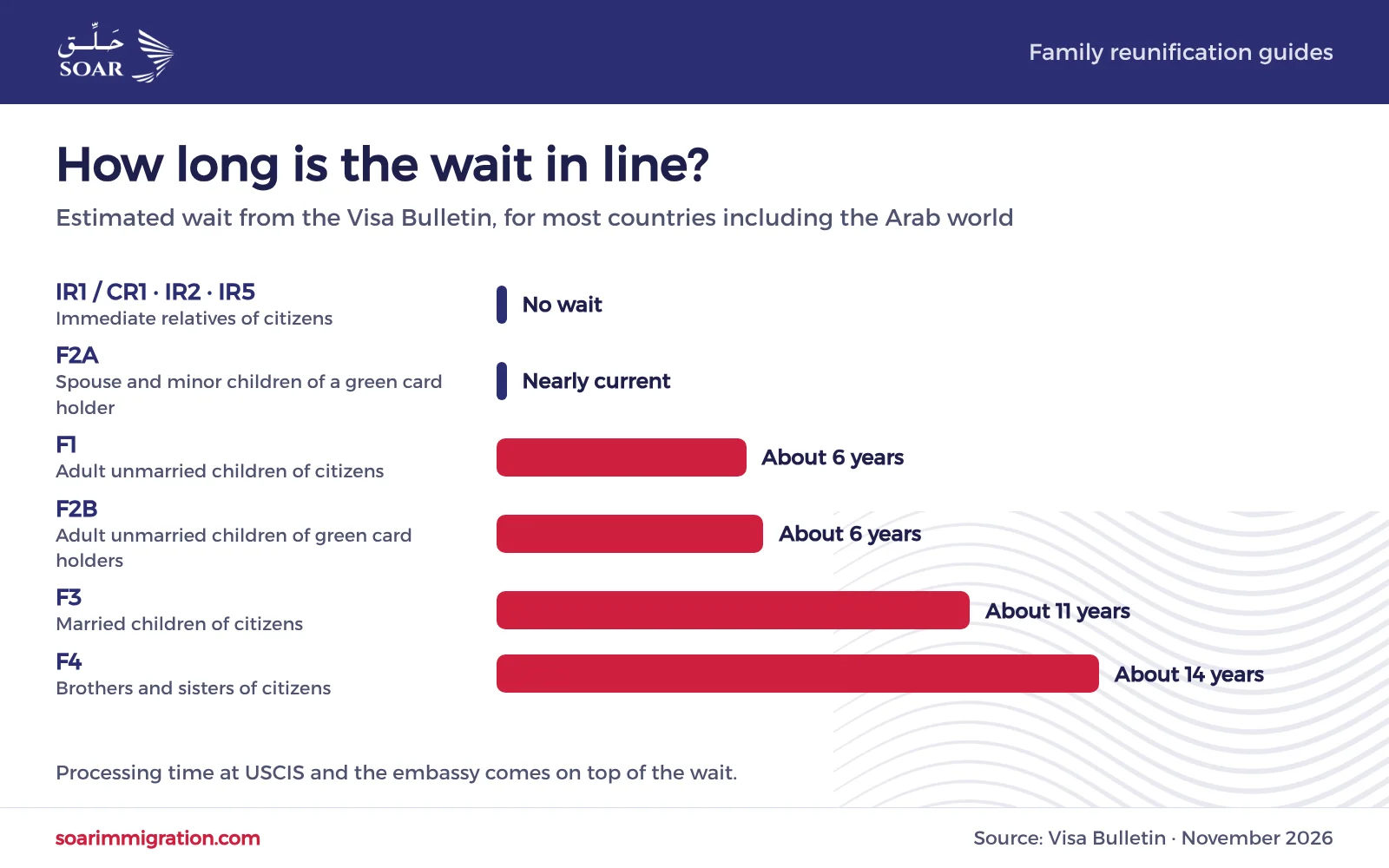
Short answer: immediate relatives take roughly one to two years. Preference categories range from a few months to more than a decade, depending on the category.
| Category | Who it covers | Time in line today |
|---|---|---|
| IR1 / CR1, IR2, IR5 | A citizen’s spouse, unmarried minor children and parents | None. Processing time only |
| F2A | Spouse and children under 21 of a green card holder | Very short today, nearly current |
| F1 | Unmarried sons and daughters of citizens, 21 or older | About 6 years |
| F2B | Unmarried sons and daughters of green card holders, 21 or older | About 6 years |
| F3 | Married sons and daughters of citizens | About 11 years |
| F4 | Brothers and sisters of citizens | About 14 years |
Estimates are based on the gap between the November 2026 bulletin and each category’s Final Action Date for most countries. Your actual timeline may be shorter or longer, because the lines move at different speeds from month to month.
Visa Bulletin dates: November 2026
These are the Final Action Dates for family categories for most countries, including the Middle East. If your priority date is before the date for your category, your turn has come this month.
| Category | Who it covers | Final Action Date |
|---|---|---|
| F1 | Unmarried sons and daughters of citizens, 21 or older | 22 January 2021 |
| F2A | Spouses and children under 21 of green card holders | 22 October 2026 |
| F2B | Unmarried sons and daughters of green card holders, 21 or older | 22 August 2020 |
| F3 | Married sons and daughters of citizens | 22 October 2015 |
| F4 | Brothers and sisters of citizens | 22 October 2012 |
For a full explanation of how to read the bulletin and its two charts, see the Visa Bulletin explained.
What delays a case?
- Requests for Evidence (RFE): usually caused by a missing document or weak proof of the relationship.
- Civil documents that don’t meet requirements: each country has a specific list at the State Department.
- A weak Affidavit of Support: when the sponsor’s income is not enough and no joint sponsor is added.
- Administrative processing after the interview: can take weeks or months in some cases.
- Policy decisions: such as the worldwide rescheduling of immigrant visa interviews since August 2026, and entry restrictions on certain nationalities.
What speeds a case up?
- Filing the petition early, since your place is held from the receipt date.
- Filing online where available, which is also $50 cheaper.
- Preparing civil documents and translations before your turn comes.
- Answering any USCIS or NVC request quickly and completely.
- If a green card holder sponsor becomes a citizen, the category may move to a faster route. That step is worth calculating with the lawyer.
Common questions
How long does it take for a U.S. citizen’s wife?
She does not wait in line, so the timeline is processing time only, usually one to two years from filing the petition to the visa, depending on USCIS and the embassy.
How long does a sibling case take in 2026?
In the November 2026 bulletin, F4 is processing cases with priority dates before 22 October 2012 for most countries, so the wait is more than a decade. That is why filing as early as possible matters.
Can I see where I am in the line?
Yes. Compare the priority date on your receipt notice with your category’s date in the monthly Visa Bulletin. If your date is earlier, your turn has come.
Does the wait depend on my country?
Middle Eastern countries follow the “all chargeability areas” column. But interview scheduling and administrative processing can vary from one embassy to another.
Official sources
- U.S. Department of State: Visa Bulletin
- USCIS: Which chart applies this month
- USCIS: Processing times
- USCIS: Form I-130
- USCIS: Fee schedule G-1055
This guide is general information, not legal advice. Legal advice and representation come from a licensed U.S. immigration lawyer. Laws, fees and dates change often, so always check the official sources.