
U.S. family reunification in 2026: who qualifies, how long it takes, and how to start
In short
- Every family case starts with a relative in the U.S. who is a citizen or green card holder and files Form I-130 for you.
- Spouses, unmarried children under 21 and parents of citizens aged 21 or older are not subject to the annual limit. These are the fastest routes.
- Other relatives wait their turn in an annual line. The wait depends on the category, and the dates are published each month in the Visa Bulletin.
- The USCIS fee for the petition is $625 online or $675 on paper, per relative.
What is U.S. family reunification?
Family reunification, or family-based immigration, is how a U.S. citizen or green card holder sponsors a relative for permanent residence in the United States. The relative abroad does not apply on their own. The case starts with the sponsor in the U.S.
Two things decide the route and the wait: the relationship and the sponsor’s status. So the first thing to know is which official category fits your family.
Who can sponsor whom?
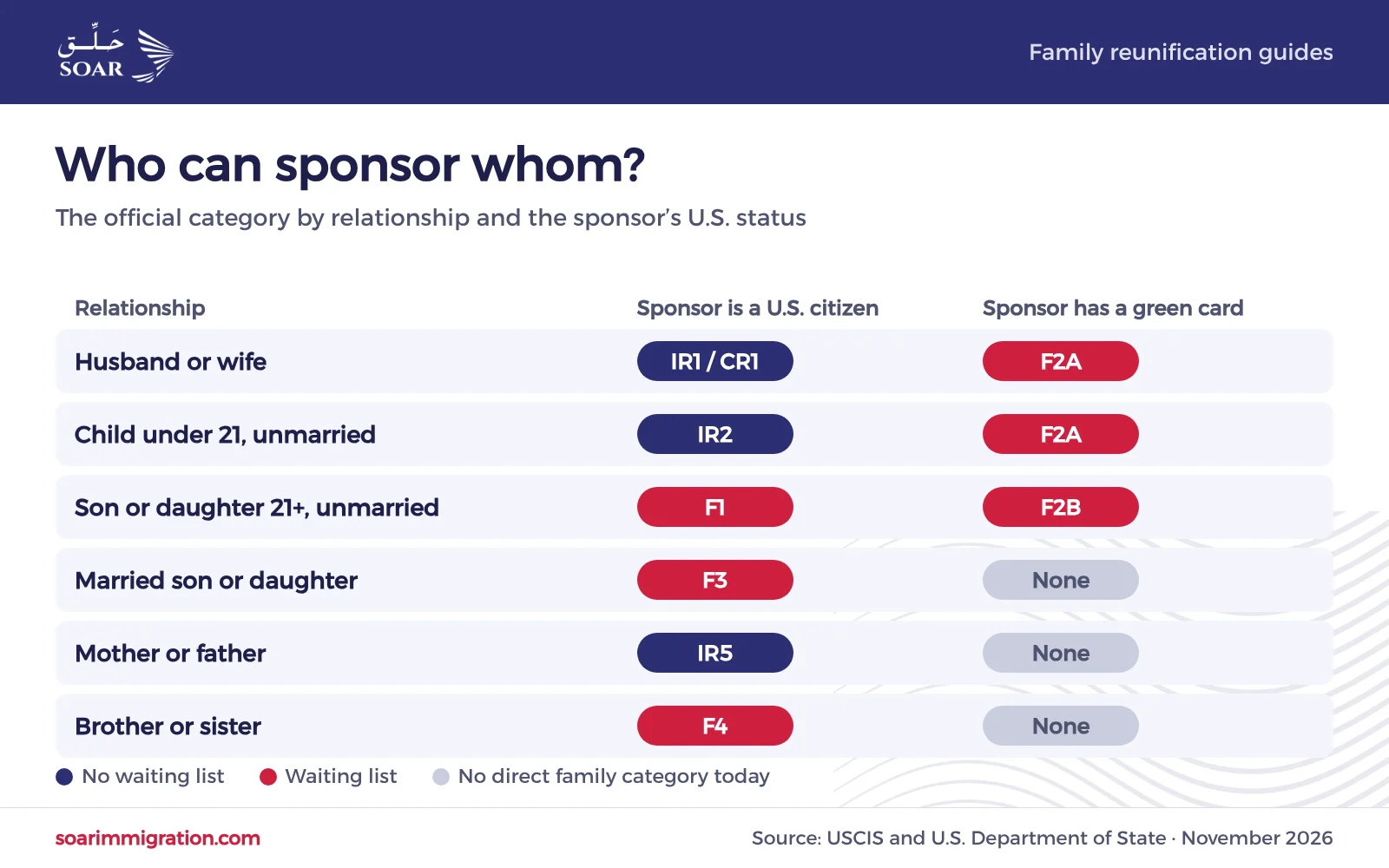
Short answer: a U.S. citizen can sponsor a spouse, children, parents and siblings. A green card holder can sponsor only a spouse and unmarried children.
| Relationship | Sponsor is a citizen | Sponsor has a green card |
|---|---|---|
| Husband or wife | IR1 / CR1, no waiting list | F2A, a relatively short wait |
| Child under 21, unmarried | IR2, no waiting list | F2A |
| Son or daughter 21 or older, unmarried | F1 | F2B |
| Married son or daughter | F3 | No direct family category |
| Mother or father | IR5, if the sponsor is 21 or older | No direct family category |
| Brother or sister | F4, if the sponsor is 21 or older | No direct family category |
If your relationship is not in the table, that does not mean the door is closed. Your relative may become a citizen later and open a new category, and there may be other options a lawyer can assess.
Immediate relatives vs. preference categories
U.S. law splits relatives into two groups:
- Immediate relatives (IR): a citizen’s spouse, unmarried children under 21, and parents if the citizen is 21 or older. There is no annual cap, so they do not wait in line. Their timeline is processing time only.
- Preference categories (F1 to F4): these have fixed annual numbers, so each case waits its turn by its “priority date”, the date USCIS received the petition.
That is why a citizen’s wife may finish in about a year or a little more, while a sibling case takes many years. The earlier the petition is filed, the earlier the place in line is held.
How long does family reunification take?
Short answer: for immediate relatives, usually one to two years depending on USCIS and embassy processing. For preference categories, add the time in line, which today ranges from a few months for F2A to more than a decade for F4.
See the full table by category in How long it takes, and the latest official dates in the Visa Bulletin explained.
The steps from start to arrival
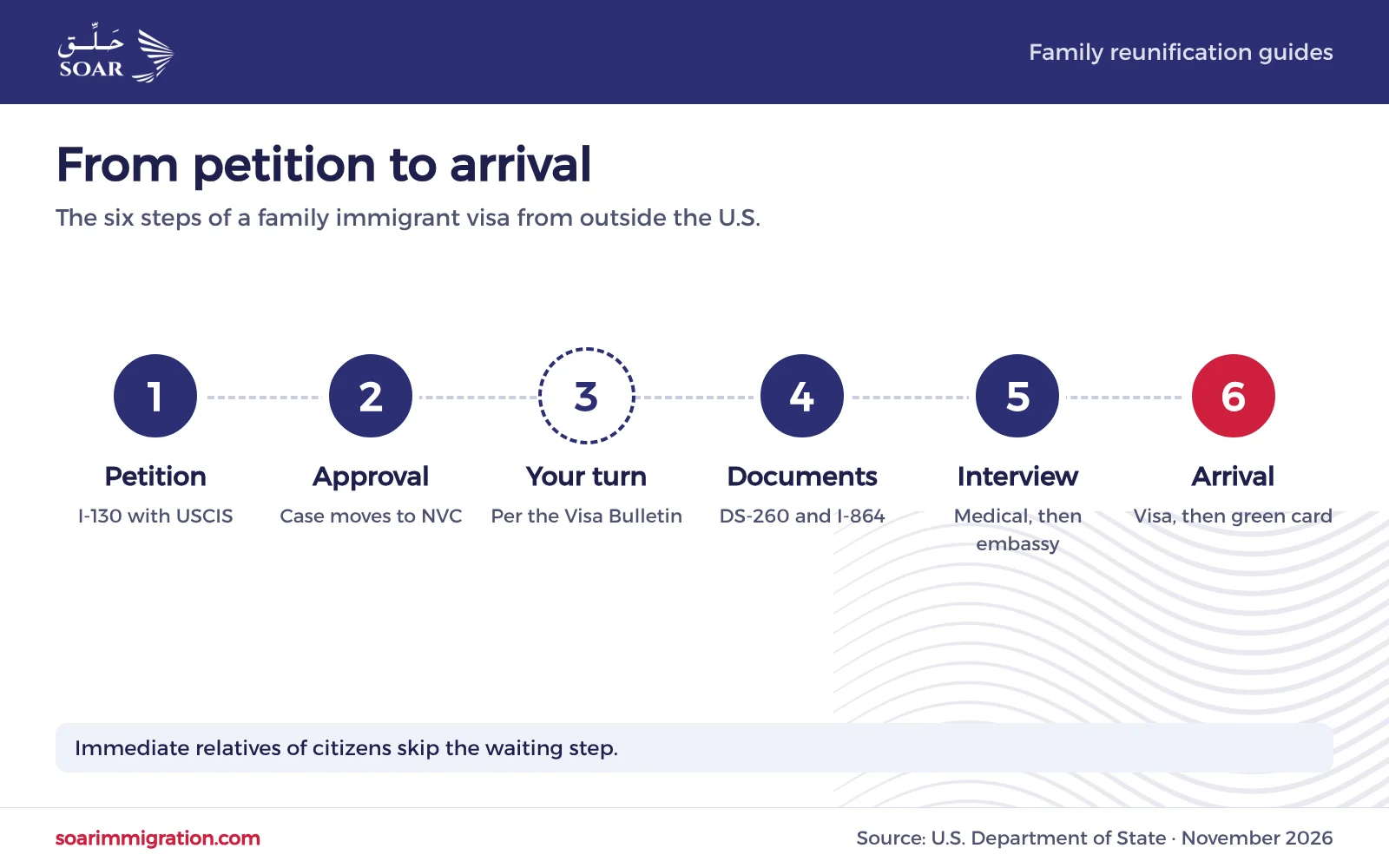
- Petition I-130: the sponsor files with USCIS, with proof of the relationship and of their U.S. status. One petition per relative.
- Approval and transfer: after approval the case moves to the National Visa Center (NVC) if your relative is outside the U.S.
- Waiting for your turn: preference categories only, until the priority date becomes current in the Visa Bulletin.
- Fees and documents: pay the visa fees, complete the DS-260 application, and submit civil documents and the sponsor’s Affidavit of Support I-864.
- Medical exam and interview: an exam with an approved doctor, then an interview at the U.S. embassy.
- Visa and travel: after approval the immigrant visa is issued, and the green card arrives by mail after entering the U.S.
How much does it cost?
The USCIS fee for Form I-130 is $625 online and $675 on paper, according to the official fee schedule, paid separately for each relative. After that come the visa-stage fees at the Department of State, the USCIS immigrant fee, and the costs of the medical exam, translations and documents. Through the embassy route, government fees usually exceed $1,300 per person before the medical exam.
Fees change from time to time, so we check them with you before each step, and we set out the lawyer’s fees and ours in writing before you commit to anything.
What changed in 2026?
2026 brought important changes that directly affect families in the region:
- Entry restrictions (Presidential Proclamation 10998): since 1 January 2026, visa issuance, including immigrant visas, has been suspended for nationals of several countries, among them Syria, Yemen, Sudan, Libya, Somalia and Iran, and for holders of travel documents issued by the Palestinian Authority, with limited exceptions. Partial restrictions cover immigrant visas for nationals of Mauritania.
- The 75-country pause was struck down: the pause on immigrant visa issuance that began on 21 January 2026 and covered Jordan, Egypt, Iraq, Lebanon, Morocco and others was vacated by a federal court on 21 August 2026, and the State Department confirmed it is no longer in effect.
- Interview rescheduling: since 25 August 2026 many immigrant visa interviews worldwide have been rescheduled while consular officers train on new “public charge” standards. As of October 2026 the State Department had not announced a general date for normal scheduling to resume.
If your relative’s nationality is on a restricted list, do not assume the road is closed. Exceptions exist, and the picture can change if they hold a second nationality. That is exactly what the lawyer assesses in a consultation.
Common mistakes that delay a case
- Waiting to file “until things are clearer”, and losing valuable time in line.
- Missing civil documents or uncertified translations, so the case comes back with a request for more.
- Sponsor income too low for the Affidavit of Support, without adding a joint sponsor.
- Not updating your address or email with NVC, so messages are missed.
- A child turning 21 during the wait without checking age protection under the CSPA.
Common questions
Can a green card holder sponsor their parents?
There is no family category for that. A green card holder can sponsor only a spouse and unmarried children. After becoming a citizen and reaching 21, they can sponsor their parents as immediate relatives.
Do I need to travel to apply?
No. The sponsor in the U.S. files the petition, and you follow the next stages up to the interview at the U.S. embassy.
What if my son turns 21 while we wait?
He may move to a category with a longer wait, but the Child Status Protection Act (CSPA) may calculate his age in a way that keeps his category. This needs a precise calculation by the lawyer.
Do you guarantee approval?
No one can honestly do that. The decision belongs to the U.S. authorities alone. What we commit to is an organized file and clear follow-up in your language.
Official sources
- U.S. Department of State: Family immigration
- USCIS: Form I-130
- USCIS: Fee schedule G-1055
- U.S. Department of State: Visa Bulletin
- U.S. Department of State: Suspension of visa issuance (Proclamation 10998)
- U.S. Department of State: The immigrant visa process
This guide is general information, not legal advice. Legal advice and representation come from a licensed U.S. immigration lawyer. Laws, fees and dates change often, so always check the official sources.