
Sponsoring a spouse for the U.S.: citizen vs. green card holder
In short
- A U.S. citizen’s spouse is an immediate relative (IR1 or CR1) and does not wait in line.
- A green card holder’s spouse falls under F2A, which has a very short wait today.
- If the marriage is under two years old on entry, a two-year conditional green card is issued (CR1).
- The key to the case is proving the marriage is genuine, not just legally valid.
Who can sponsor a spouse?
Short answer: both a U.S. citizen and a green card holder can sponsor a spouse, but the route and timeline differ.
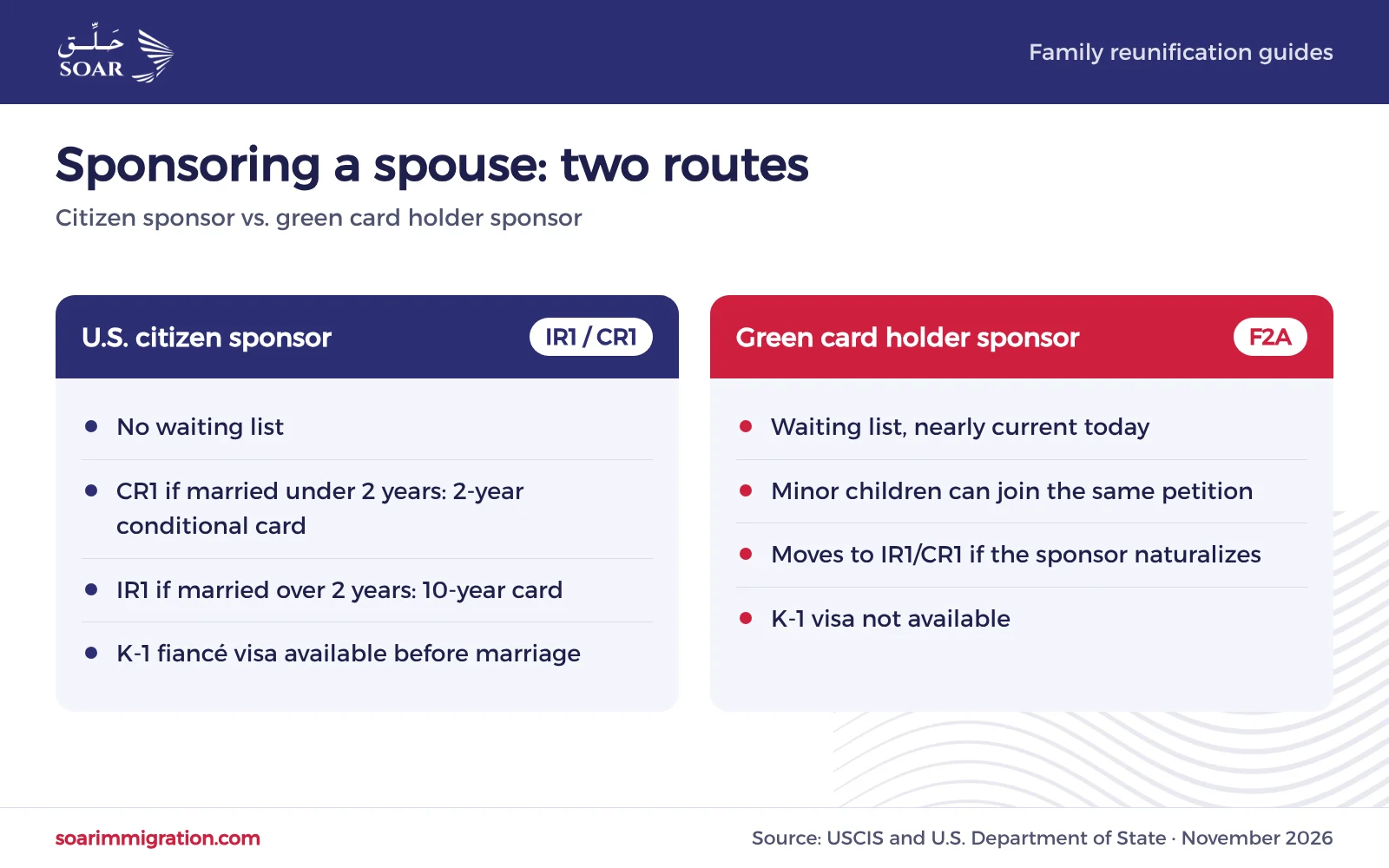
| Citizen sponsor | Green card holder sponsor | |
|---|---|---|
| Category | IR1 / CR1 | F2A |
| Waiting list | None | Yes, nearly current today |
| Spouse’s minor children | Usually need their own petitions | Can join the spouse’s petition |
| K-1 fiancé(e) visa | Available before marriage | Not available |
What is the difference between IR1 and CR1?
Both are for a U.S. citizen’s spouse. The difference is how long the marriage has lasted on the day of entry to the U.S.:
- CR1: married less than two years. The spouse receives a conditional green card valid for two years, then the couple files Form I-751 in the 90 days before it expires to remove the condition.
- IR1: married more than two years. A permanent green card valid for ten years is issued.
The steps are nearly identical until the interview, and you do not choose the category yourself.
How long does a spouse case take?
For a citizen’s spouse: processing time only, usually one to two years from petition to visa. For a green card holder’s spouse: about the same while F2A is nearly current. Its Final Action Date in the November 2026 bulletin is 22 October 2026 for most countries.
If the green card holder sponsor becomes a citizen during the wait, the case moves automatically to the immediate relative category.
How do you prove the marriage is genuine?
A marriage certificate proves the marriage is legal, but U.S. officials want to see that it is real and not only for immigration. Useful evidence includes:
- Photos together across the relationship, not just the wedding day.
- A record of regular contact, and visits documented with tickets and passport stamps.
- Any shared commitments: a bank account, a lease or insurance.
- Birth certificates of children you have together, if any.
You don’t need all of this at once. An organized, consistent file that tells a clear story is enough, and that is what we help you prepare.
Core documents
- Proof of the sponsor’s citizenship or green card.
- The marriage certificate, and proof that any previous marriage of either spouse has ended.
- Passport photos to the required specifications.
- The evidence of a genuine marriage listed above.
- Later, at NVC: the spouse’s civil documents, police certificates, and the sponsor’s Affidavit of Support I-864.
Accepted civil documents vary by country, and the State Department publishes a specific list for each.
Is the K-1 fiancé(e) visa a better option?
The K-1 visa is only for a U.S. citizen’s fiancé(e). It allows entry to the U.S. to marry within 90 days, then complete residence from inside the country. It suits some situations, but it means two steps and extra fees. Choosing between it and marrying first, then CR1, is a decision to make with the lawyer based on your circumstances.
Common questions
Can my green card holder husband sponsor me?
Yes, under F2A. Its wait is very short today, so the timeline may be close to that of a citizen’s spouse.
We married recently. Does that hurt the case?
No. Recent marriages are very common. The difference is that you will likely receive a two-year conditional card (CR1), then remove the condition with Form I-751.
Do we need to have met in person?
For the K-1 fiancé(e) visa, an in-person meeting within the previous two years is usually required, with limited exceptions. For an existing marriage, meeting in person remains one of the strongest proofs of a genuine marriage.
What is the minimum income for the sponsor?
On the Affidavit of Support I-864, the sponsor’s income usually needs to reach 125% of the federal poverty guidelines for their household size. If it falls short, a joint sponsor can be added.
Official sources
- USCIS: Form I-130
- U.S. Department of State: Family immigration
- USCIS: Form I-751
- USCIS: Affidavit of Support I-864
- U.S. Department of State: Fiancé(e) visa K-1
- U.S. Department of State: Documents by country
This guide is general information, not legal advice. Legal advice and representation come from a licensed U.S. immigration lawyer. Laws, fees and dates change often, so always check the official sources.